
Engineering & Tech
“We’re Building a Racecar”: Inside UConn FSAE’s Push for the Podium
Balancing simulation with hands-on fabrication, UConn’s Formula SAE team fields internal combustion and electric vehicles for collegiate competition at Michigan International Speedway.
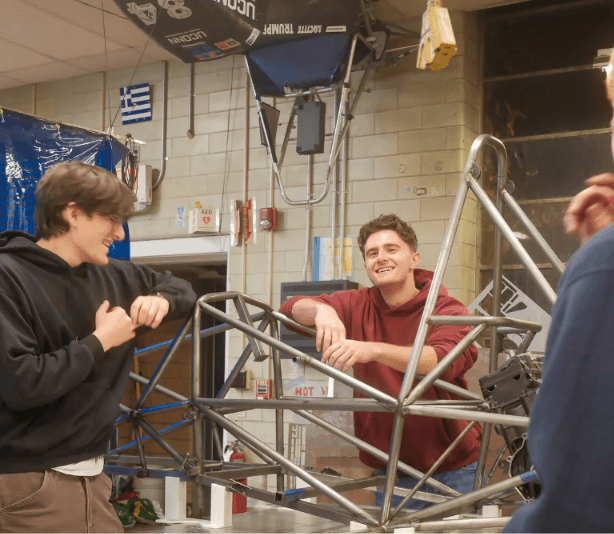
“We win and lose together.” This quote from seven-time Formula 1 World Champion Lewis Hamilton resonates deeply with UConn’s very own Formula SAE team. Formula SAE (Society of Automotive Engineers) is a student-run organization where collegiate engineers and enthusiasts come together to design and manufacture a formula-style racecar.
The team works out of one of the university’s off-campus facilities, where dedicated members collaborate long into the night. UConn fields two vehicles, an internal combustion (IC) car and an electric vehicle (EV), competing annually at the Formula SAE competition at Michigan International Speedway.
There, teams are evaluated by seasoned industry judges across static events like engineering design, cost analysis, and business presentation, as well as rigorous dynamic track events. Club president Jake Gannon (Mechanical Engineering ’27) discussed the team’s technical, financial, and organizational strategies as they prepare for the spring competitions in May and June.
Simulation-driven engineering and iterative design
Engineering a high-performance racecar demands rigorous precision. To ensure high-fidelity measurements and predictive models, the team utilizes an industry-standard engineering software suite.
3D component and chassis assemblies are developed in SolidWorks, structural integrity and factors of safety are validated under simulated loads using ANSYS Workbench (FEA), and complex vehicle dynamics equations are modeled in MATLAB. Roughly 90% of the car’s design begins in these simulations.
However, not every system needs to be rebuilt from scratch every year. Depending on regulations and component lifecycle, certain assemblies carry over across seasons without requiring redesign. Each year, SAE International publishes an updated rulebook spanning 70 to 80 pages detailing specifications for every onboard system. While key technical regulations evolve annually, the overarching framework remains stable, allowing for iterative engineering.
Even so, the team executes “full redesigns if it feels worth it for either weight savings or better overall design cleanliness/simplicity,” explained Henry Bissonnette (Mechanical Engineering ’26), the team’s Frame Lead.
Specialized subsystems and technical mentorship
To execute such complex machines, the organization is divided into specialized subsystems. Overseen by IC and EV Chief Engineers, disciplines include Aerodynamics, Business, Composites, Controls, Data Acquisition, Electrical Safety, Low/High Voltage Electronics, Finance, Frame, Manufacturing, Suspension, and Powertrain.
Each subsystem is spearheaded by a student lead responsible for overseeing design, testing, and manufacturing while interfacing directly with adjacent systems. The racecar is ultimately the sum of its subsystems. Through this structure, upperclassmen mentor younger members, ensuring technical institutional knowledge transfers seamlessly from one class to the next.
Grassroots support and industry backing
External backing from industry sponsors is equally vital. Building competitive open-wheel racecars requires significant capital and technical resources, and sponsors support the team in multifaceted ways.
Beyond direct financial contributions, corporate partners supply raw materials, machine custom components, provide testing instrumentation, and offer engineering mentorship. Many partner companies also send representatives to UConn’s shop to meet team members and recruit for engineering internships and full-time positions.
In addition to corporate partnerships, the team relies on grassroots support from alumni, family, and friends during UConn Ignite, the university’s annual giving campaign. This year, the team raised more than $20,000, more than doubling their initial $10,000 target.
“At the beginning of the year, we were nervous about our ability to afford two cars, but the team gave such an extra push it was a really incredible outcome,” Gannon said. The fundraising milestone delivered a major morale boost heading into peak manufacturing season.
Powered by student dedication
With a multidisciplinary team of this scale, members bring a wide range of backgrounds and skill levels.
“Formula SAE is a place for me to forget about classes, exams, and everything that was going wrong in college life,” Gannon reflected. “At the end of the day, this club is all built on passion. We’re all full-time students. We are not here because we have to be; we are here because we want to be.”
Every member plays a role in pushing the car closer to competition, with an organizational culture centered on mentorship and passing the torch each season. For Gannon, the goal is simple: empowering leads and general members alike to pursue hands-on engineering that genuinely excites them.
As Bissonnette put it: “I mean, we’re building a racecar; it’s pretty cool.”
- Automotive engineering
- Formula SAE
- Electric vehicles
- Finite element analysis
- Student design
Faith Hosie
Contributing Science Writer
UConn Undergraduate Science Journal