
Art & Science
Sculpting Space and Time: How Chris Sancomb Turns Black Holes into Art
By translating LIGO waveforms, solar flare telemetry, and astronaut EKGs into marble and metal, industrial designer Chris Sancomb bridges empirical astrophysics and human emotion.
Science seeks to illuminate the unseen, the unknown, the unimaginable. Scientists rely on equations, schematics, and models to represent phenomena like spacetime curvature, cellular machinery, or molecular bonding. Equations and models help us describe phenomena, but they don't necessarily tell us what these things look or feel like.
When we study phenomena that exist beyond the limits of human perception, we find ourselves reaching for ways to make the abstract tangible, the invisible visible, and the unimaginable conceivable.
Scientists themselves undergo rigorous training and years of experience and specialization to comprehend this mysterious, abstract realm. But how do we—non-specialists, who haven’t spent years struggling through and understanding mathematics—understand and conceptualize objects and events beyond the human scale?
Perhaps this is where art can help.
Translating the invisible into form
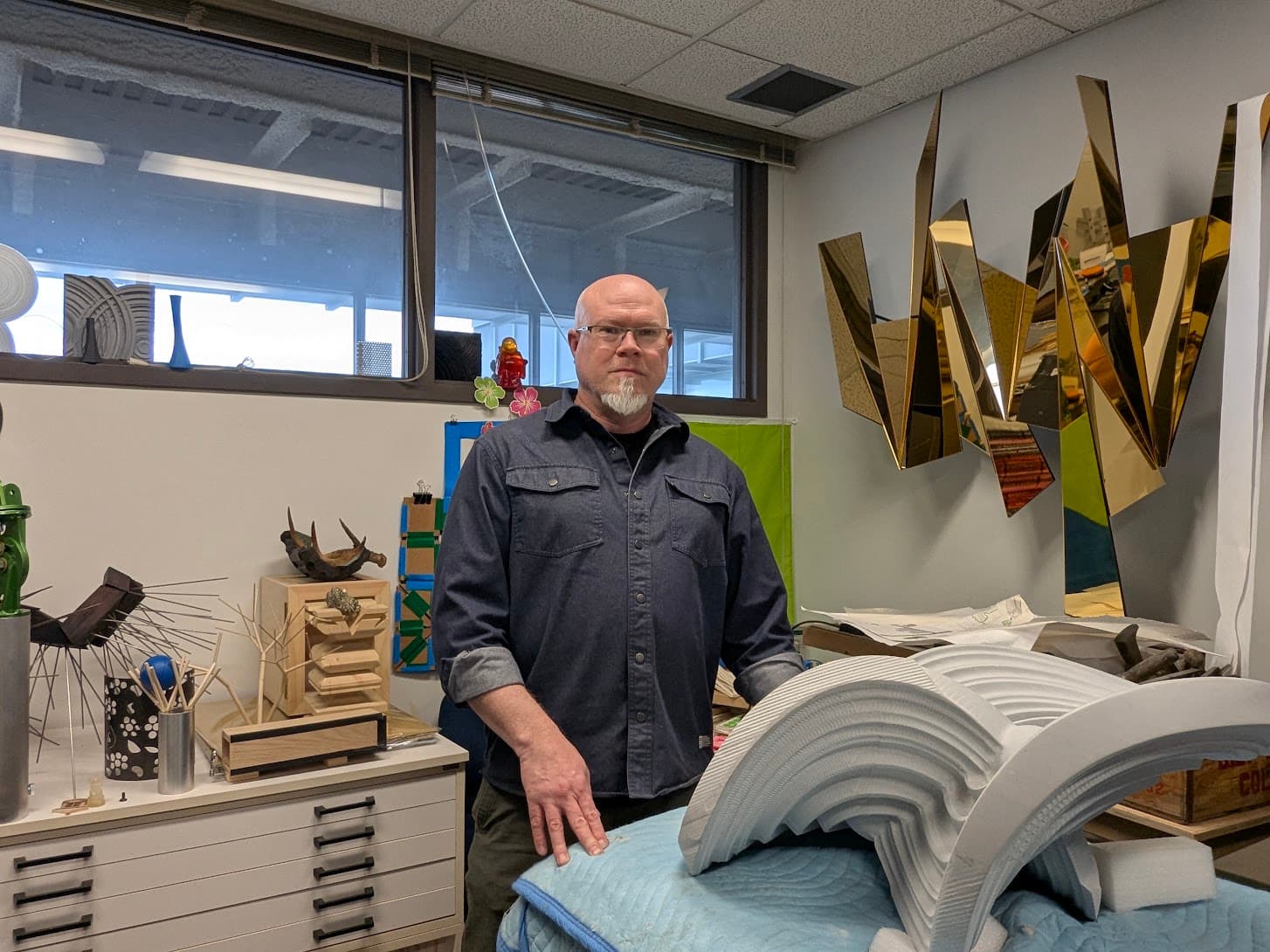
Chris Sancomb is a Professor of Industrial Design at the School of Fine Arts at UConn. His work focuses on using art and design as tools to comprehend science. A studio artist, designer, and educator, Sancomb takes scientific data and phenomena that are often impossible to experience directly and translates them into physical forms that we can see, touch, and contemplate.
Art has long been used to comprehend things that are difficult to explain rationally: death, love, beauty, and wonder. From a physical perspective, these things can seem almost trivial, but their effect on the human experience is indelible. Our ability to understand them in a human way is a never-ending endeavor. Sancomb approaches science in a similar way. His purpose is not simply to represent scientific information, but to make us feel the science, to be touched by its intrigue, its mystery, and its beauty.
Deep time etched in stone: Gravitational waves
His work Every Star Eclipsed at the Same Time is a sculptural representation of gravitational waves, created to commemorate their scientific discovery in 2015. The sculpture combines interpretive form with scientific data, featuring two twisting discs that symbolize the powerful forces of colliding black holes. The surfaces of the discs are engraved with machined grooves based on actual data collected by LIGO.
But the material itself is just as important as the data. Marble, formed over millions of years through heat and pressure, was chosen to reflect the deep time and scale of the event. A material shaped by geological processes becomes a physical reminder of timescales that are almost impossible for us to comprehend. The black hole collision may exist far beyond our perception, but the marble allows us to encounter a small piece of that vastness through something tangible. Data, material, and design come together to give physical form to an otherwise invisible event.
Solar storms and human telemetry
The Sun I See Today takes a different approach. The work is a data-driven sculpture generated from solar flare activity over a one-year period. The geometry of each triangle is based on storm activity, using duration and intensity to determine its length and angular characteristics. The pieces are then combined to create a prismatic form that represents a year of activity on our Sun.
Here, something that would otherwise appear as a collection of numbers becomes a physical record. The sculpture allows the viewer to see a year of solar activity as a single object. Time, intensity, and duration—things that are normally represented through graphs and measurements—become geometry and material.
In Slice of Life, Sancomb brings this idea even closer to the human experience. The work was developed in response to the first human walk on the Moon by Neil Armstrong in July of 1969. The silver-toned radial pattern in the lower corner was created using electrocardiogram (EKG) data from Armstrong’s walk, giving physical form to the electrical signals sent by the human heart.
Here, the heartbeat becomes a data point used to reflect the sense of wonder felt among the stars. The EKG waveform was used to create a shaping blade, first to shape plaster and create the pattern, and then to cast it into metal. The surrounding dark space provides a stark contrast to the bright radial wave. Composed of jagged, angular clusters of wood, it appears as an empty and dark void bursting with invisible activity, crafted to impress upon the viewer a sense of scale—a beacon compressed against a dark particle stream of space.
Context, curiosity, and wonder
What makes the work interesting is this movement between the measurable and the emotional. An EKG is simply data, electrical signals produced by the human heart. But when that data belongs to the heartbeat of a person walking on the Moon, it becomes something more. It becomes a record of a human being experiencing one of the most extraordinary moments in history. The data does not change, but the meaning we attach to it does.
Context is crucial to his art. Looking at a work without context can be intriguing, but having some background information of what you are looking at adds another layer of interpretation. Knowing that the grooves in Black Holes come from actual LIGO data, or that the pattern in Slice of Life comes from Armstrong’s heartbeat, changes the way you see the objects. The science gives the art meaning, while the art gives the science a way to enter human experience.
This is central to Sancomb’s work. The aim, as he puts it, is “to create a sense of awe and wonder.” The next time you hear about a scientific discovery in the news or read about it in a science magazine, perhaps you can associate that event with a feeling of awe and mystery. That feeling might push you to pursue the subject further, to become curious about something that otherwise might have remained distant and abstract.
For Sancomb, this process begins with curiosity. “I am very interested in science,” he says, and curiosity drives him to work. He hears about something and gets really interested in it. Then he takes some data and plays around with it, trying to put it into a form. This process of playing around with form and creation is itself very important to him. Even if no one gets to see the work, this part remains meaningful.
We may never be able to perceive a collapsing star or the bending of spacetime with our own senses. We may never truly comprehend billions of years in the way we comprehend a day. But perhaps we don't always need to understand the unimaginable mathematically before we can begin to understand it as human beings.
Sometimes, we can begin with wonder.
- Data physicalization
- Astrophysics
- Sculpture
- Industrial design
- Gravitational waves
Pragyan Yadav
Director of Journalism
UConn Undergraduate Science Journal