
Ecology & Evolutionary Biology
Plant Parenthood at UConn’s Botanical Conservatory
Behind the humid glass of UConn’s teaching and research greenhouses, Dr. Cynthia Jones investigates the evolutionary forces shaping plant morphology while conserving species on the brink of extinction.
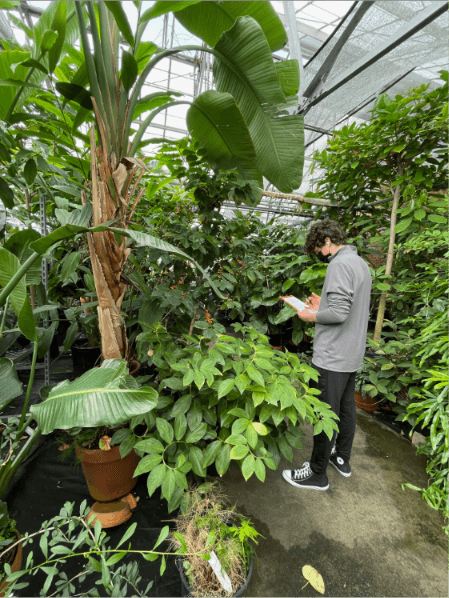
Walking past the Botanical Conservatory at the University of Connecticut, most students see a glass building filled with tropical plants and sunlight. What they don’t see is the decades of research, teaching, and the career of Dr. Cynthia Jones, emeritus faculty in Ecology & Evolutionary Biology and Director of the Conservatory.
The Conservatory itself is often mistaken for a single greenhouse, although it is actually two. The original structure, built in 1960, was a research space for the former Botany Department. However, by the 1990s, it had aged to the point where it could no longer reliably support research.
To meet new needs, UConn built advanced research greenhouses on top of the Biology/Physics Building. That is where Dr. Jones’ research plants live today, while the Conservatory below now focuses on teaching, outreach, and public display. These spaces are parts of the Biodiversity Research Collection, which includes both preserved specimens and living plants.
Finding purpose in the field
Dr. Jones’ path into plant biology began with her grandmother. Growing up, she spent summers camping in Colorado, where her grandmother would take her out to pick flowers and later press them into arrangements. “I used to love going to their house,” she says, noting how those experiences instilled an early curiosity about plants and the outdoors.
She entered college planning to go to medical school, but after enrolling in an introductory biology course, she found herself captivated by the plant section. “I just loved it, I really just loved it,” she says simply.
She later enrolled in an ecology class and, sitting around a campfire after a day of research transects, she thought: I can’t believe people get paid to do this. The combination of science and being outdoors felt like the right fit, and from that moment she knew plant biology was the path she wanted to follow. After a bachelor's degree at UC Santa Barbara, a master’s at UC Riverside, and a Ph.D. at UC Berkeley, she moved across the country to Connecticut, joining UConn’s Department of Ecology and Evolutionary Biology.
Challenging conventions in plant morphology
Dr. Jones’ research asks a straightforward but important question: why do plants look the way they do?
She has always loved being around plants, but what drew her into research was learning how their shapes and forms often reflect the environments they grow in. Plant morphology—the size and shape of leaves, stems, and other structures—can be influenced both by genetics and by environmental pressures like temperature, rainfall, or drought.
Her primary focus has been on the genus Pelargonium, the group that includes the familiar household “geraniums.” Native to South Africa, these plants show incredible diversity. Some grow as tiny underground tubers that only appear during rainy seasons, while others become tall shrubs thriving near water. Their leaf shapes vary widely, making them an ideal group to study.
For a long time, scientists believed leaf shape was closely tied to temperature, operating under the hypothesis that deeply lobed leaves cool more effectively by releasing heat into the air. While this pattern holds true in many plant groups, Dr. Jones and her collaborators found that Pelargonium breaks the mold. In this genus, leaf shape doesn’t reliably match temperature; instead, factors like rainfall and seasonal variation play a far more dominant role.
This discovery challenged a long-standing assumption in plant biology and demonstrated the necessity of evaluating plants within an evolutionary context. To understand why species differ, researchers must consider both their current habitat and the ancestral environments in which they evolved.
Dr. Jones’ research also highlights phenotypic plasticity—the capacity of plants to alter their growth patterns in response to ambient conditions. Because plants continuously produce new leaves and shoots throughout their lifespans, they actively respond to internal and external cues. Not all species respond identically, making the comparative study of plant lineages central to the emerging field of eco-evo-devo (ecological evolutionary developmental biology).
Rescuing species on the brink of extinction
One of the Conservatory’s most remarkable stories illustrates why living botanical collections matter.
Solanum ensifolium, a rare species in the tomato family native to Puerto Rico, had nearly vanished following Hurricane Maria and decades of severe habitat loss. By 2018, the plant was presumed extinct in the wild, and botanical research gardens across Puerto Rico had lost their collections as well.
That year, a Puerto Rican graduate student reached out to UConn and discovered that the Conservatory still maintained two living genotypes—quite possibly the last surviving specimens on Earth. Without those plants, the species might have been permanently lost.
Fortunately, a researcher in Utah located a single compatible cutting. With that addition, cross-pollination became possible, allowing graduate student Brian Connolly to cultivate hundreds of new plants and restore critical genetic diversity. Today, those efforts have expanded into a collaborative reintroduction initiative with Puerto Rican conservation authorities to reestablish Solanum ensifolium in its native habitat.
The fragile green foundation of ecosystems
For Dr. Jones, the Conservatory serves as far more than a teaching collection—it is a vital reminder of humanity's dependence on the botanical world. She cautions that plants are frequently overlooked, relegated to background scenery rather than recognized as the ecological bedrock of the planet.
“Ecological communities are a lot like Jenga,” she explains. “You can take some pieces out and it holds for a while, but if you lose enough, the whole system collapses.” Even when vegetation regrows, the original diversity and equilibrium are permanently diminished.
Dr. Jones highlights a striking physical metric: if all plant biomass on Earth were distributed evenly across the globe, it would form a layer only three to four inches tall. That remarkably thin stratum of life generates the oxygen and trophic foundations supporting global ecosystems, yet human development routinely clears forests and plows prairies with little regard for the loss.
“People look at a hillside and just see a big green smear,” she says. “But every plant has a story, and an evolutionary past.”
Within the Conservatory walls reside species that no longer exist in the wild, dependent entirely upon curated stewardship. Beyond species preservation, the facility provides an accessible sanctuary where students encounter plant diversity firsthand. Recognizing the physiological and psychological benefits of these encounters, Dr. Jones helped launch Nature Rx at UConn, a campus initiative encouraging students to spend time in green environments to alleviate stress and support mental health. Stepping into the warm, humid air of the greenhouse on a freezing winter day can feel restorative.
Despite its impact, the future of the greenhouses remains uncertain. The eventual demolition of the aging Torrey Life Sciences building threatens the adjacent greenhouse structures. This reality makes broader public engagement and preservation advocacy urgent.
“We have to make people aware of what an extraordinary resource this is,” Dr. Jones emphasizes. “And I want as many students as possible to appreciate it while it’s here.”
- Plant biology
- Conservatory
- Eco-evo-devo
- Conservation
- Biodiversity
Lakshmi S. Parankusham
Contributing Science Writer
UConn Undergraduate Science Journal
References & Selected Reading
- Lee MS, Lee J, Park BJ, Miyazaki Y. Interaction with indoor plants may reduce psychological and physiological stress by suppressing autonomic nervous system activity in young adults: a randomized crossover study. J Physiol Anthropol. 2015 Apr 28;34(1):21. doi: 10.1186/s40101-015-0060-8.
- Bar-On YM, Phillips R, Milo R. The biomass distribution on Earth. Proc Natl Acad Sci U S A. 2018 Jun 19;115(25):6506-6511. doi: 10.1073/pnas.1711842115.