
Earth & Environment
Overspending Carbon: How the Anthropocene Broke Earth’s Budget
Human activity has tipped the balance of Earth's dynamic carbon budget, driving climate change and triggering cascading disruptions across marine ecosystems.
Have you ever considered the true scope of a “carbon footprint”? The phrase is widely used to describe the total greenhouse gas emissions an individual, organization, or industry releases into the atmosphere over a given period. Today, Earth has entered what many scientists term the Anthropocene, a geological epoch defined by human activity becoming the dominant influence on climate and the environment.
For generations, society operated under the assumption that our planet was simply too vast for human industry to disrupt. Countless ecological studies have since disproven this notion, demonstrating how global environmental systems are shifting in direct response to anthropogenic activity. At the center of this disruption lies a massive, unprecedented influx of carbon into the biosphere.
Understanding the global carbon balance
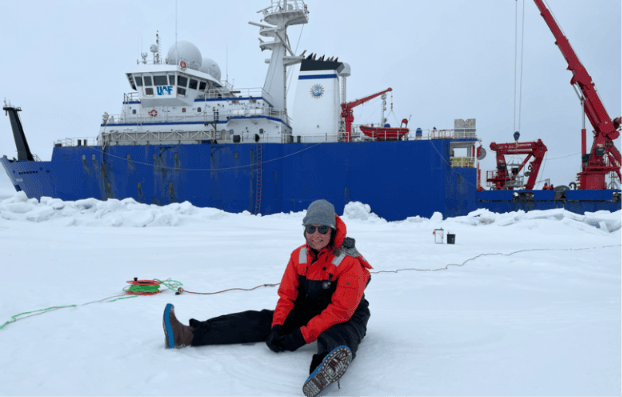
At the University of Connecticut Avery Point, Dr. Penny Vlahos studies the global carbon cycle, specializing in how biogeochemical changes impact coastal ecosystems. The carbon cycle is Earth’s natural mechanism through which carbon exchanges between living organisms, the oceans, the atmosphere, and the terrestrial crust.
Under natural conditions, it operates within an equilibrium: a dynamic carbon budget balancing uptake and release. However, as human activities pump carbon into the atmosphere at rates exceeding natural absorption, that balance breaks down, driving global climate change. According to Vlahos, our best defense begins with empirical understanding: “Our best defense to climate change is to understand the budget of carbon, where it’s going and where it’s coming from, because it is so critical for understanding climate and making future projections on this important resource.”
Ocean sinks and microscopic regulators
Much of that surplus carbon ends up in the world's oceans, which serve as Earth’s primary carbon sink. Marine organisms, particularly microscopic primary producers, drive this uptake.
“Phytoplankton and cyanobacteria are photosynthetic. These are the organisms taking up that carbon, just like on land. It’s the same story, just looks a little different,” Vlahos explained. Cyanobacteria in particular hold a profound place in Earth's history; through the Great Oxidation Event billions of years ago, they generated the atmospheric oxygen that paved the way for complex multicellular life.
Cascade effects: Acidification and harmful algal blooms
Yet marine ecosystems are struggling to absorb today’s carbon overload. As seawater absorbs excess carbon dioxide, ocean acidification intensifies, disrupting marine chemistry. Compounding these pressures are harmful algal blooms (HABs)—rapid proliferations of algae and cyanobacteria that cloud water columns, deplete dissolved oxygen, and synthesize dangerous biotoxins that degrade water quality.
Understanding HAB dynamics is the focus of an ongoing collaborative project between Vlahos’s team and Dr. Dianne Greenfield, a biological oceanographer at the City University of New York (CUNY).
“We’re working in conjunction with Dianne Greenfield... She is the phytoplankton specialist working with the harmful algal blooms, while our lab handles the chemical analysis,” Vlahos noted. Their field research in Long Island Sound is critical for building reliable coastal water-monitoring frameworks that can provide early warnings to aquaculture managers and the public.
“We classify these blooms as harmful when they release toxins into the water, and these toxins produce distinct physiological effects across different marine organisms,” Vlahos elaborated. In addition to threatening wild marine life, these toxins pose severe hazards to commercial shellfish aquaculture: filter-feeding oysters and clams can accumulate high toxin concentrations, making them unsafe for human consumption.
Science as the baseline for action
From atmospheric heat trapping to coastal acidification and toxicity, surplus carbon disrupts interconnected biomes across land, air, and sea. Understanding concepts like the carbon footprint and carbon budget is the first step toward confronting these challenges.
Across UConn labs and coastal research stations, scientists like Dr. Vlahos are delivering the baseline data needed to predict, mitigate, and adapt to these shifts. As Vlahos encouraged the next generation of researchers: “Keep up the good work. Make sure to educate yourself and others, and never stop learning!”
- Carbon cycle
- Anthropocene
- Ocean acidification
- Marine ecology
- Climate change
Faith Hosie
Science Writer
University of Connecticut