
Physics & Astronomy
Bringing UConn’s Planetarium Back to Life
Through volunteer momentum and digital projection, Assistant Professor Matt Guthrie restores a dormant campus fixture into an accessible universe simulator.
The first time Matt Guthrie saw the planetarium, he was driving around a campus he had never actually set foot on. It was 2020, and UConn existed for him mostly as a series of video calls and email threads. He’d been hired as an adjunct to teach physics, but never asked to show up in person. So one day, he showed up anyway.
The first building he saw was the planetarium, and it stopped him cold. It was unused and overlooked, but still standing. “At a time where there was a lot of uncertainty and really scary things happening,” Guthrie recalled, “I saw the planetarium and I felt a little bit of comfort.”
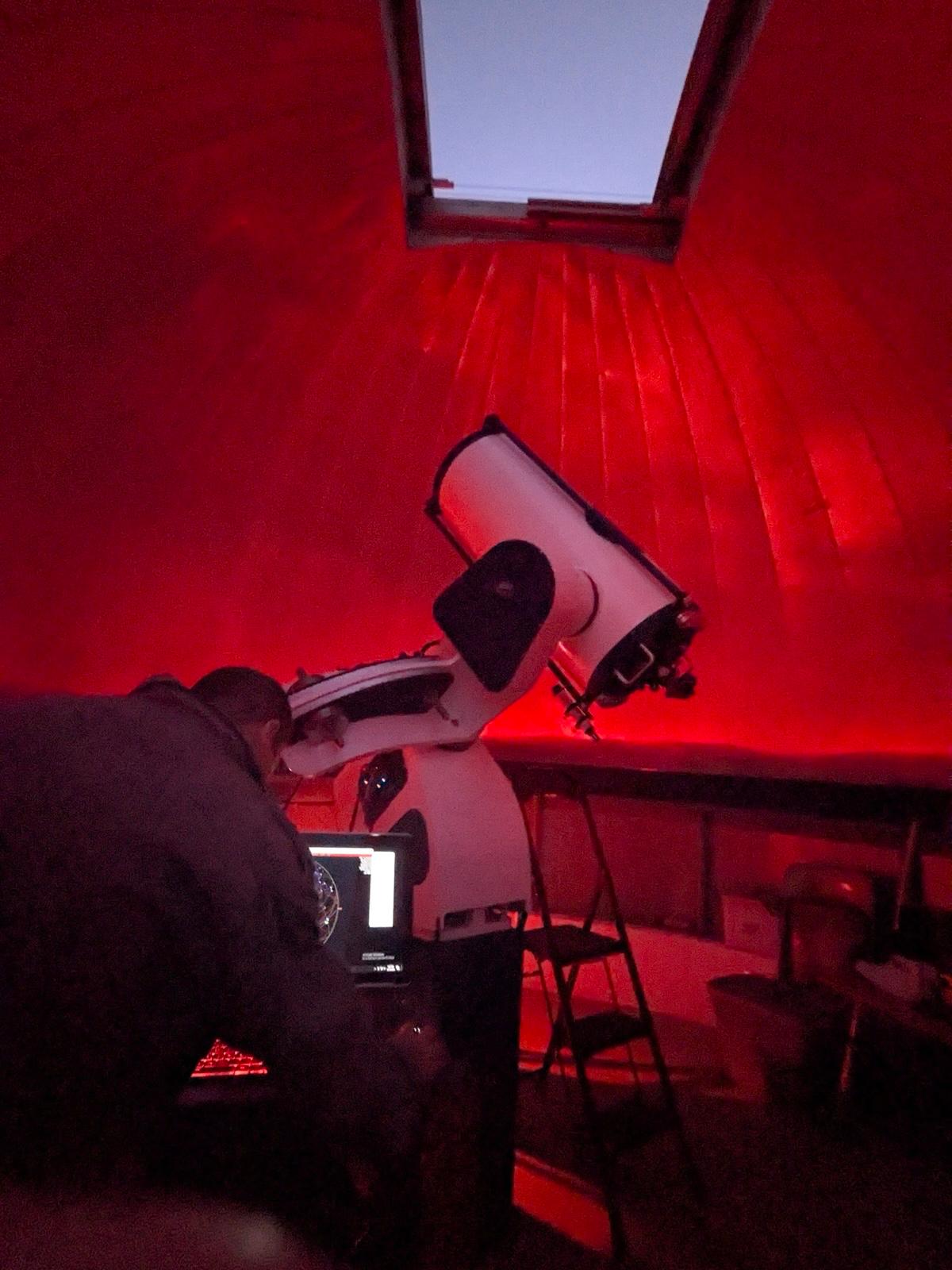
That instinct—noticing what’s been forgotten and refusing to leave it that way—turned out to define his time at UConn. Since joining the department full time in January 2022, Guthrie has overseen the revival of two dormant facilities: the campus planetarium and an off-site observatory that had been shut down since 2009. Neither project came with a roadmap. Neither came with much money. They came with his willingness to figure it out.
How he got here
Guthrie is an assistant professor in residence in the physics department, teaching introductory physics and astronomy. He earned his Ph.D. in physics from the University of Texas in 2018 and completed a postdoc at the University of Central Florida before arriving at UConn as an adjunct in 2020.
Because of COVID, every one of his classes remained virtual until 2022, the year he transitioned to full-time faculty. Three courses a semester left gaps in his schedule, and rather than let them sit empty, he started looking for something productive to do with the time. His department head mentioned that the campus planetarium was just sitting there.
The idea stuck because it was personal. Guthrie’s earliest scientific memory is of a small inflatable planetarium his first-grade teacher rented for the class, an experience that fundamentally changed how he viewed the stars. Being able to see and predict the motion of the night sky was something he had never considered before, and he wanted to give UConn students and the broader community that same experience.
His research focuses on how students learn physics, emphasizing inclusive group work, accessibility, and disability in STEM. He contributes to the NSF-funded Courses to Careers project, working alongside disabled physics students and instructors to identify and dismantle systemic barriers in science education and careers. That dedication directly informs his stewardship of both campus astronomical facilities.
Modernizing the dome: From 1950s mechanics to cosmos simulation
The planetarium’s previous director, Dr. Cynthia Peterson, who also ran the observatory, continued coming to work well after earning professor emeritus status. She passed away in 2020, and with her went the institutional knowledge of how to operate either space. The planetarium fell into disuse, though it had not been dark nearly as long as the observatory.
Guthrie drafted a funding proposal to the dean, who approved the initiative. The grant secured a new digital projector and updated seating, enabling Guthrie to collaborate closely with university facilities and physics colleagues to renovate the interior.
The original projector was a 1950s optomechanical design that had never been upgraded. Guthrie never saw it running, but previous audiences reportedly had to sit in total darkness for up to ten minutes just for their eyes to dilate enough to discern dim projections on the dome. The modern digital projector is bright enough to eliminate the waiting period entirely.
It functions less like a conventional star projector and more like a real-time universe simulator. Audiences can navigate across the cosmos, fly to specific celestial bodies, and watch them evolve over millennia. Because the system computes celestial mechanics algorithmically rather than projecting a static star plate, it accurately simulates axial precession: Earth’s axis slowly wobbles over deep time, shifting which star marks true celestial north. While Polaris holds that distinction today, Vega in the constellation Lyra will eventually take its place.
Designing an interactive, accessible space
The room's mismatched seating—a patchwork of metal folding chairs and aged plastic shells arranged around the perimeter—was replaced with modular, movable seating. This flexibility accommodates both traditional concentric rings and a forward-facing semicircle suited for modern presentations where focus centers on dynamic visualizations.
The building’s central campus location makes it inherently accessible. While the vintage reel-to-reel tape player once used for audio is defunct, a dedicated surround sound installation is currently underway. As a self-described audio enthusiast who appreciates vintage sound equipment, Guthrie notes that once fully calibrated, “it’s gonna shake the room.”
The entire operational model runs on student initiative and volunteer effort. Presenters write and curate their own dynamic planetarium programs, cross-training so members can run each other's shows seamlessly.
Rather than queuing passive, pre-rendered dome films, Guthrie and his team present live astronomy demonstrations controlled directly via an iPad interface. Presenters frequently pivot off-script to field questions from the audience, show live orbital perspectives, and return smoothly to the program. Balancing rigorous science education with public entertainment remains an ongoing craft, but the community reception speaks for itself: shows continue to sell out.
- Astronomy
- Planetarium
- STEM education
- Physics
- Accessibility
Ganga Nomika Mahesh
Contributing Science Writer
UConn Undergraduate Science Journal